Commercial Truck Body Repair for Class 3 to Class 7 Units
Commercial truck body repair at OCRV Center covers the cab shell on Class 3 through Class 7 units: doors, hoods, fenders, bumpers, cab mounts and cab guards, plus refinish that matches an existing fleet colour. Posted cab body repair runs $750 to $12,000 across 5 to 60 hours. Engine and drive system work is not performed.
Ballpark range $1,500 to $50,000 at 10 to 250 hours of labor. See the posted rate card.
Class 3 Through Class 7, and Why the Range Matters
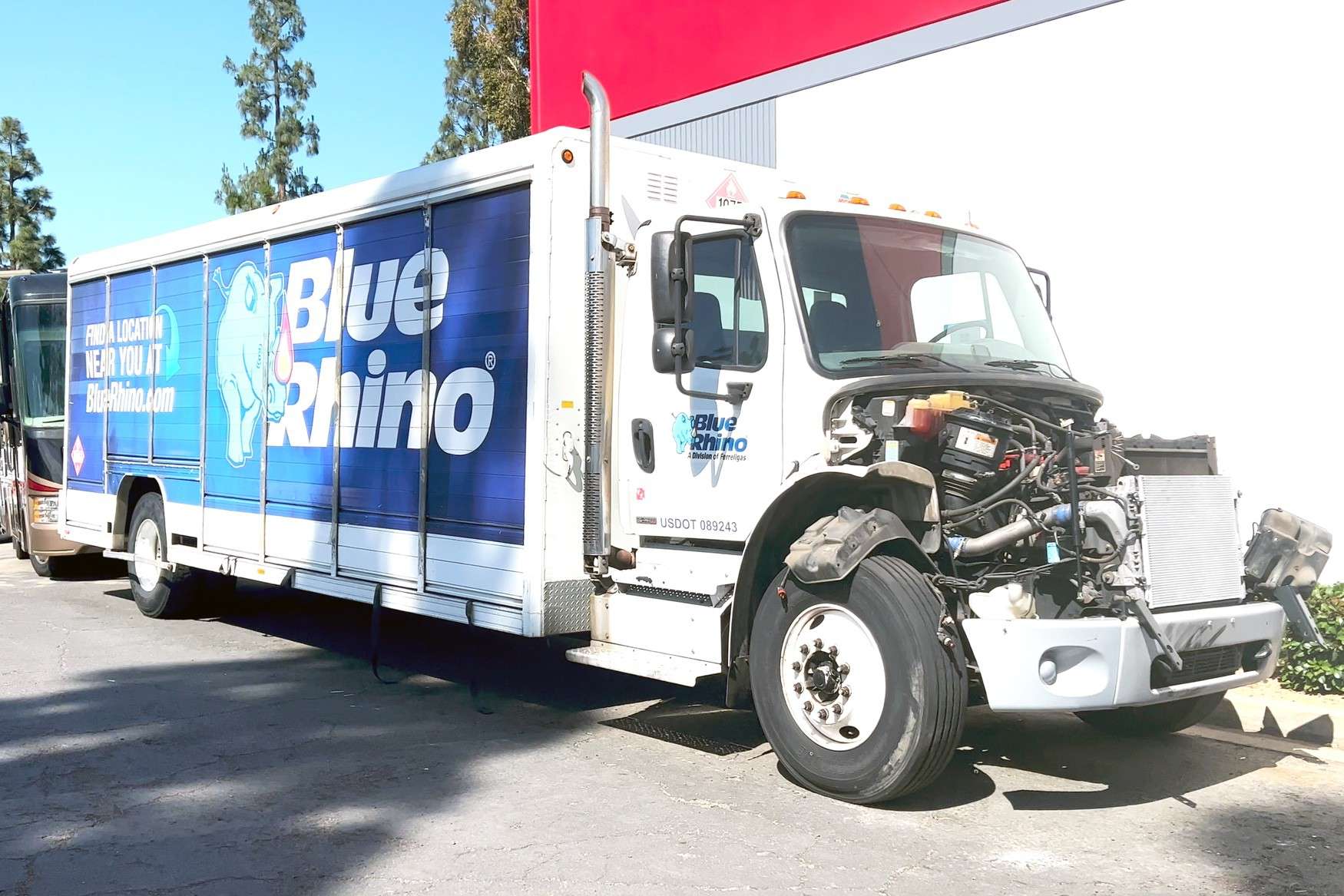
A Class 3 truck at 14,000 pounds and a Class 7 at 33,000 pounds get treated as one category by fleet software and as two very different animals by a body technician. The lighter end shares a lot of hardware with heavy pickups: bolt on fenders, stamped steel hoods, unitized bumpers. The heavier end moves toward what you see on a tractor: tilting fiberglass hood assemblies, separate bumper mounting brackets that bolt through the frame horn, cab mounts that carry real isolation duty.
The practical consequence is that a quoted hour figure means nothing without the class. A door skin on a Class 3 is a few hours. The same nominal job on a Class 7 with a wide cab, an air deflector and a mirror arm bracketed through the door frame is a different animal because everything comes off before the panel does. Posted cab body repair, covering door, hood, fender and bumper, is $750 to $12,000 at 5 to 60 hours, and the class is the first thing that tells the estimator where in that band the job sits. The rest of the posted bands are on the prices page.
Doors, Hoods, Fenders and Bumpers on a Working Cab
Commercial cabs collect a specific pattern of damage because of how they get used. Doors take dock post strikes at the trailing lower corner where the driver swings out on a tight turn. Fenders take wheel spray abrasion at the arch and then rust from the inside out. Bumpers take low speed contact that transfers straight into the mounting brackets, so the visible bend on the bumper face is often the smaller half of the repair.
Hoods are their own conversation. A hood that no longer closes evenly is very rarely a bent hood. It is a shifted latch striker, a tired hinge bushing, or a cab that has settled on its mounts, and replacing the hood without checking those three things buys you a very expensive nonsolution.
Bumper repair and panel replacement detail is covered on the bumper repair and replacement page. Where a panel is beyond straightening, panel replacement is the path.
Fiberglass Hood or Steel Hood: Two Repairs, Not One
Steel hoods dent, crease and pull. A skilled hand and a stud welder can bring most of a steel hood back if the crown is intact. Fiberglass hoods do not dent. They flex until they crack, and the crack usually runs from a mounting boss or a corner radius where the laminate is thickest and least able to move.
Repairing fiberglass means grinding a scarf back on both faces, laying glass with resin, and rebuilding the contour before any filler touches it. Skip the back side and the repair telegraphs through the paint within a season of highway flex. It is slower work than steel, and it is the reason a fiberglass hood repair and a steel hood repair with identical visible damage can quote hours apart.
There is also a decision point. On a heavily cracked fiberglass hood with damaged mounting bosses, replacement is often the honest recommendation, because the bosses are what hold hood alignment and a rebuilt boss is a compromise. The estimator will tell you which side of that line your hood is on rather than starting the repair and discovering it in hour six.
Cab Mount Bushings and How a Hit Loads Them
This is the part fleets miss most often. The cab does not sit on the frame. It sits on isolators, and those isolators are the first thing a lateral impact loads. A hit to the driver side of a cab pushes the whole shell across its mounts, and the mount hardware absorbs that before the sheet metal does.
- Torn or crushed bushing
- The cab sits low on one corner. The symptom the driver reports is a door that scrapes or a hood gap that closed up, not a mount problem.
- Elongated mount hole in the bracket
- The cab can shift under load and returns to a slightly different position every time. Door fit changes depending on which way the truck was last cornering.
- Cracked cab mount bracket at the frame
- Often invisible from above. Found by getting under the truck with a light and looking at the weld toe on the bracket, which is exactly where fatigue cracks start.
- Sheared or stretched mount bolt
- Torque feels normal at first pull, then the bolt keeps turning. Replace, never retorque.
If mounts are ignored and the body is repaired around them, every panel gap on that side of the truck is being aligned to a cab in the wrong position. That is how a truck leaves looking correct and comes back in two months with a door that binds.
Headache Racks, Cab Guards and Fleet Colour
Headache rack and cab guard installation is posted at $750 to $3,500 across 4 to 14 hours. The hour spread is not about the rack. It is about what the rack has to mount to. A bolt through pattern into an existing flatbed headboard is quick. A fabricated mount that has to pick up frame rail points, clear an exhaust stack and preserve access to the back of the cab is a fabrication job, and it goes to the welding and metal fabrication bench.
Colour across a mixed age fleet is the other thing that separates a fleet job from a retail job. A five year old truck and a one year old truck wearing the same corporate white are not the same white. Solar exposure in Orange County chalks a single stage finish measurably, and matching to the paint code produces a panel that is visibly brighter than everything around it.
The method is to spray a card, put it against the actual adjacent panel in daylight and under the booth lights, adjust the toner, and blend into the neighbouring panel rather than cutting the repair off at a body line. Panel blending is posted at $500 to $5,000 for 4 to 25 hours and is almost always the right call on a fleet unit.
Downtime Cost and Why Parts Get Staged First
A commercial truck that is not on a route is a fixed cost with no revenue attached to it. That number is usually larger than the repair, which changes how the job should be sequenced. The wrong sequence is: tear down, discover, order, wait. The right sequence is: assess, order, confirm on the shelf, then tear down.
We write the estimate with the truck assembled wherever the damage allows it, order and receive the panels and hardware, and only then bring the unit into a bay. That turns a two week hole in your schedule into a predictable block. It is also why the estimator asks so many questions up front about which side got hit, what the truck struck, and whether anything sounded different afterward.
One more thing worth stating plainly: this is a body, paint and structural shop. We do not touch the engine or the drive system on a Class 6 truck, and we do not perform roadworthiness certification. The cab shell, the mounts, the paint and the bolt on equipment are ours. Everything mechanical under the hood stays with your maintenance vendor, and we are happy to coordinate timing so the truck sees both shops in one downtime window.
Questions we get asked
My hood does not close square after a minor hit. Is the hood bent?
Usually not. Check the latch striker, the hinge bushings and the cab mounts first. A cab that has settled a few millimetres on a crushed isolator produces exactly this symptom, and replacing the hood will not fix it. We measure the cab position before quoting a hood.
Can a cracked fiberglass hood be repaired instead of replaced?
Often yes, if the mounting bosses are sound. The crack is scarfed from both faces, glass and resin are laid up, and the contour is rebuilt before filler. If the bosses that hold hood alignment are damaged, replacement is the more honest answer and the estimator will say so before starting.
Will a repaired panel match the rest of my fleet colour?
That is the goal, and it is why we blend into adjacent panels rather than stopping at a body line. Older units chalk and fade, so we match to the truck rather than to the factory paint code. Panel blending is posted at $500 to $5,000 for 4 to 25 hours.
Do you install headache racks and cab guards?
Yes, posted at $750 to $3,500 for 4 to 14 hours. Bolt on patterns into an existing headboard sit at the low end. Fabricated mounts that pick up frame rail points and route around exhaust or air lines take longer and go through the fabrication bench.