School Bus Body Repair Serving Tustin Districts
School bus body repair at OCRV Center covers Type A, C and D bodies: replacing riveted steel panels between the rub rails, straightening or renewing skirt panels, refinishing in national school bus glossy yellow, and remounting stop arms, crossing gates and exit hardware. All of it happens in shop in Yorba Linda. Engine and drive system work stays with the district garage.
Ballpark range $1,500 to $50,000 at 10 to 250 hours of labor. See the posted rate card.
Which body style is on the lift?
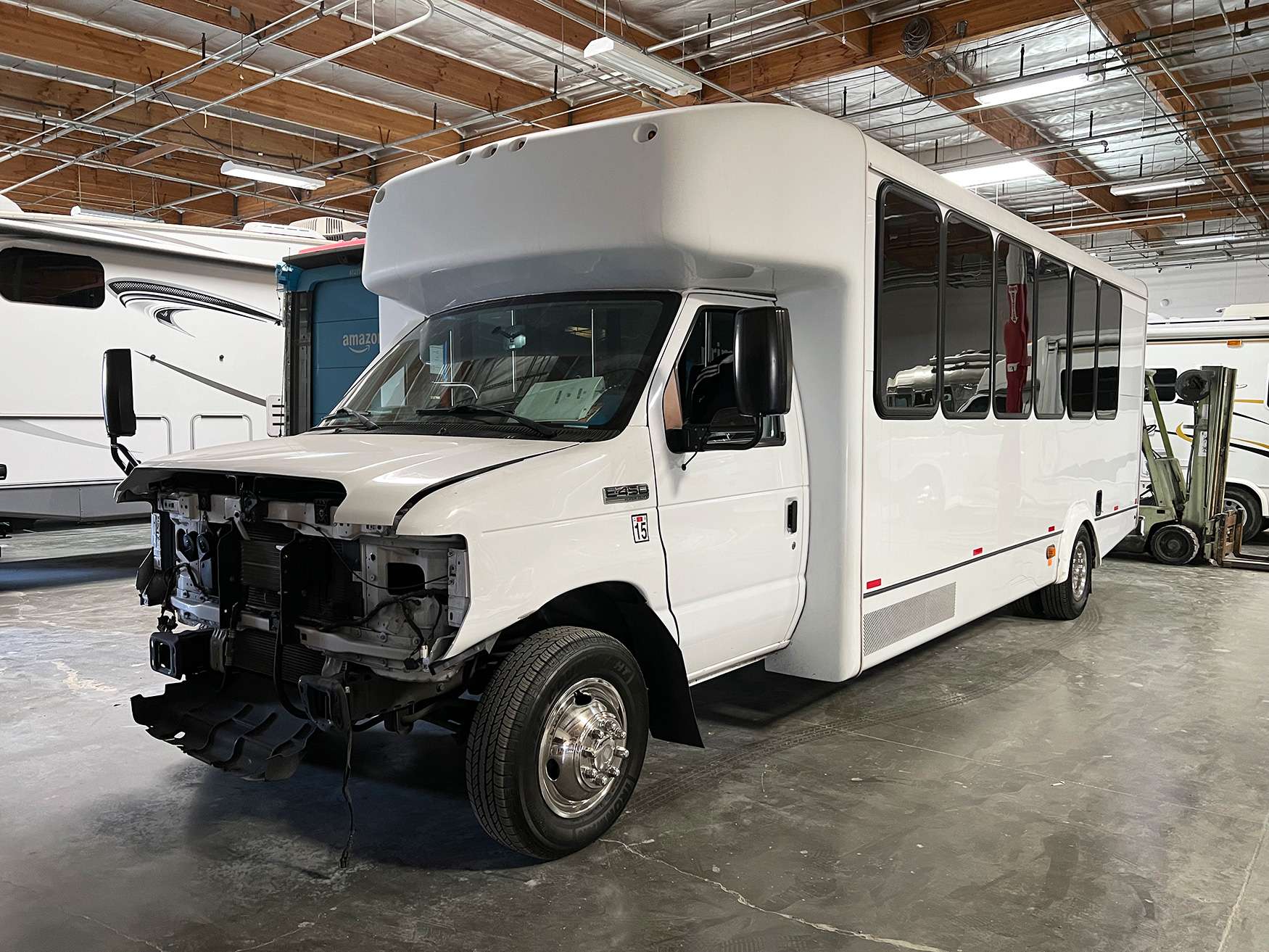
Three shapes cover almost everything a Tustin area district or contractor runs. A Type A is a bus body dropped onto a cutaway van chassis, so the front clip is passenger vehicle sheet metal and the body behind it is bus construction. A Type C is the classic conventional with the hood out front and the body starting behind the cowl. A Type D is the transit style, engine forward of the axle or at the rear, with a flat front and the entry door ahead of the front wheel.
The style dictates where a repair gets expensive. On a Type A, front damage is often two repairs in one estimate: chassis manufacturer parts up front, body manufacturer panels behind. On a Type D, a front hit lands directly on the entry door aperture and the stepwell, which is structure, not trim. Knowing which one you have before the tow arrives is half of a useful phone conversation.
How does a panel come out from between the rub rails?
School bus sides are not one skin. They are horizontal steel sheets riveted to vertical body ribs, with rub rails running the length of the bus at floor line and seat level. Those rails are structural and impact rated. Cutting through one to make a panel easier to remove is the single most common shortcut on a cheap bus repair, and it quietly downgrades the side impact behavior of the whole body.
- Map the damage against the rib spacing and mark the rivet lines above and below the affected rail bay.
- Drill out the rivets on the damaged sheet only, working from the rail edges inward so the rails stay bolted to the ribs.
- Slide the old sheet out from behind the rail flange. It comes out sideways, not outward, which is why the rails never need cutting.
- Straighten or replace the body ribs behind it, then treat bare steel before anything new goes back on.
- Fit the new sheet, set fresh rivets to the original pattern and pitch, and seal the seams the way the body builder did.
- Refinish the bay and blend into the adjacent panels.
Budget $1,500 to $50,000 for fleet collision repair and paint refinish depending on how many bays are involved, 10 to 250 hours of labor. The posted bands are on the prices page.
Why do skirt panels take the most abuse?
The skirt is the panel below the lower rub rail, and it lives about eight inches off the ground. Curbs at pickup stops, steep driveway aprons at schools and depots, and wheel stops in parking lots all attack it from underneath. The damage pattern is distinctive: a long horizontal crease with the paint scuffed off the bottom edge, often with the panel pushed inboard against the outrigger.
Two things make skirt repair worth doing right away. First, the crease usually breaks the sealer at the floor line, and water then tracks inboard along the outrigger to the plywood floor. Second, a skirt that is pushed in will foul the wheel well liner and start abrading. Straightening and refinishing a skirt bay is small work. Replacing a rotted floor edge two years later is not.
Panel blending on a repaired bay runs $500 to $5,000 at 4 to 25 hours, which is the band most single skirt jobs land in.
How is national school bus glossy yellow matched?
School bus yellow is a specified color, not a manufacturer color, and that changes the matching approach. There is a chromatic target every body builder shoots at, but the paint on a bus that has sat in Orange County sun for years has shifted, gone slightly flat, and picked up a chalky top layer. Spraying the specification straight onto a repaired bay next to a faded roof line produces a patch that reads as a patch from across the yard.
The working method is a spray out card pulled against the actual panel, checked in booth light and again outside, adjusted for how far the existing finish has drifted, then blended into the adjacent bay rather than cut hard at a rivet line. On a full unit repaint, the whole side goes at once and the drift question disappears. Full refinish work sits in the $5,000 to $35,000 band at 40 to 250 hours.
Black trim, the roof, the bumpers and lettering all get masked and reinstated to the district specification, including reflective tape and compliance marking wherever body work disturbed it.
What happens to stop arms, crossing gates and exit hardware?
The stop arm mounts through the body side into a reinforced backing plate, and the crossing gate mounts through the front bumper or the bumper support. Both are hinged, powered assemblies that get sheared off by passing traffic and by the vehicle backing into something. Remounting one is not a bolt swap: the backing plate has to be sound, the penetration has to be sealed against the interior, and the arm has to sweep its full arc without contacting the skirt or the bumper end cap.
- Emergency exit door frames get checked for square before the door is rehung. A frame pulled out of square by a rear corner hit will let the door latch but not seal, and the interlock switch will read fine.
- Emergency exit window frames are bonded and mechanically fastened. A cracked frame corner is replaced, not filled.
- The rear bumper on a school bus is a structural member bolted to body mounts through the rear framing. A hit that bent the bumper almost always bent a mount, and both get straightened or replaced together.
The scope line stays the same on every bus: bodies, panels, paint, structure, interiors and mounted hardware here, engine and drive system work back at the district garage.
Questions we get asked
Can you replace one damaged panel without repainting the whole bus?
Yes, in most cases. The bay is repaired and refinished, then blended into the panels on either side so the repair does not read as a rectangle. If the existing finish has drifted badly with age, a wider blend or a full side repaint gives the better result.
Do you cut the rub rails to get a panel out?
No. The rails are structural and impact rated, and the sheet behind them slides out laterally once the rivets are drilled. Cutting a rail to speed up removal changes how the body behaves in a side impact, so it is not done here.
How long will a bus be off the road?
A single skirt bay repair with refinish is usually a matter of days. A multi bay side rebuild with structural rib work is measured in weeks. Labor hours on fleet collision work are posted at 10 to 250 hours, and the written estimate names the figure for your unit.
Can you work on a converted school bus rather than a district unit?
Yes. Body, paint and structural work is the same job whether the unit still hauls students or has become a conversion. Interior build work on a converted bus is quoted separately from the exterior body repair.