
Sprinter Van Repair, All Badges and All Conversions
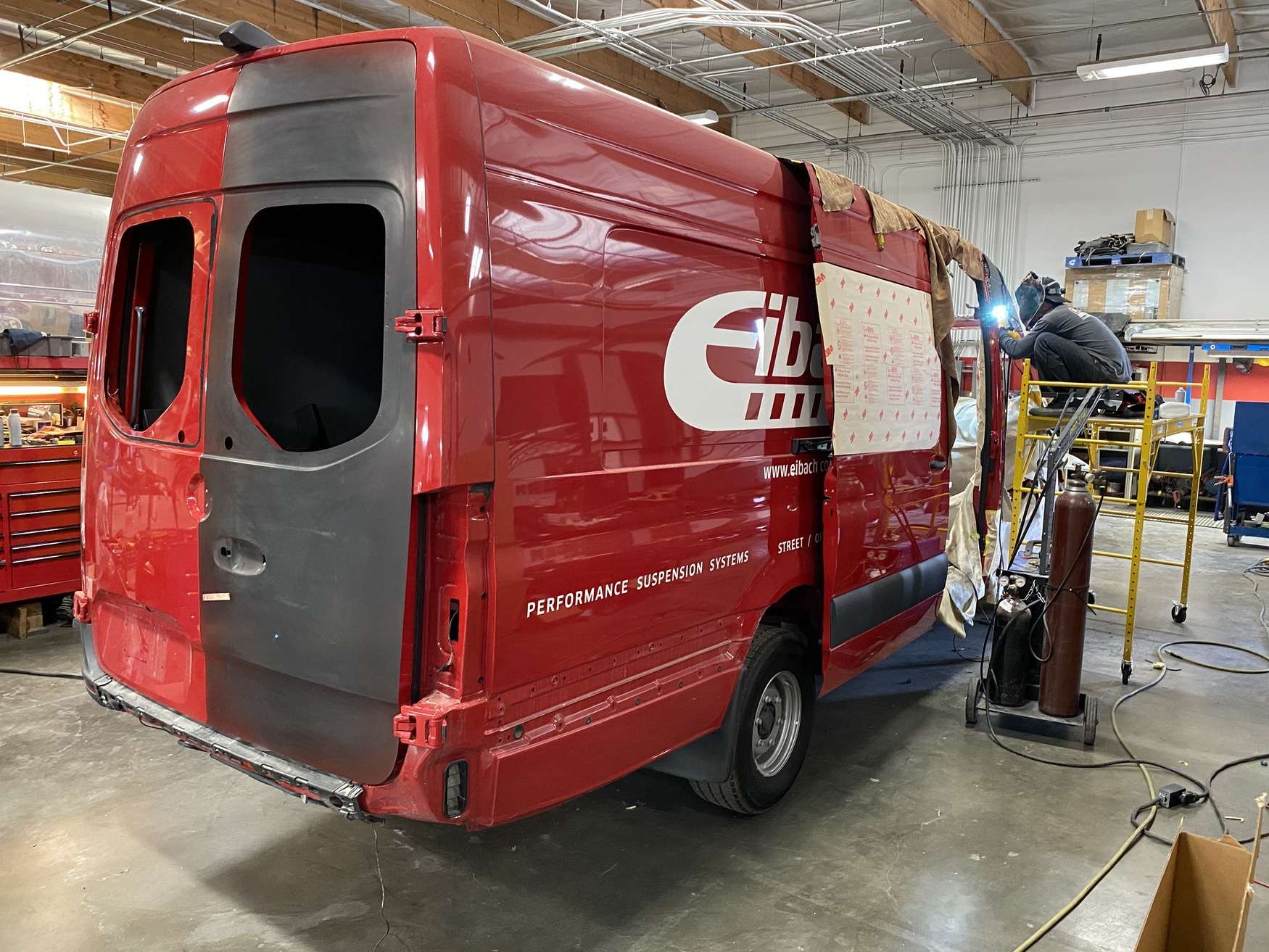
Sprinter vans wear Mercedes, Dodge and RAM badges over largely the same body, and OCRV Center repairs all of them in shop at Yorba Linda for Tustin owners. Work covers slab side panel damage, sliding door track and roller wear, sagging rear barn doors, standard and high roof panels, and the camera and radar recalibration that a bumper removal forces.
Ballpark range $1,500 to $40,000 at 10 to 200 hours of labor. See the posted rate card.
Three badges, one body, one repair plan
Three nameplates have worn this van. Mercedes-Benz sells it as the Sprinter. Dodge sold it as the Dodge Sprinter. RAM carried it for a short run as the RAM Sprinter. Under the nose badge the stampings are the same, the sliding door hardware fails the same way, and the barn door hinges sag in the same direction.
What changes between them is parts sourcing and, on the older Dodge badged units, connector and module layout. That matters for the estimate rather than for the metal: a rear quarter is a rear quarter, but a discontinued trim panel can add a week. Conversion units add another layer, because a Sprinter that left the factory as a bare cargo van may now be a camper, a shuttle, a mobile clinic or a work truck with a completely different interior in the way.
The shop treats all of them as one platform with three parts catalogues, which is faster than treating them as three vehicles. What gets confirmed at intake is the roof height, the wheelbase, the sensor package and what was added after delivery.
Why a shopping cart ding telegraphs across the whole panel
Sprinter side panels are rolled thin and hung across a very large, very flat area. Between the sliding door and the rear wheel arch there is almost no crown in the steel, just a shallow press that provides the only rigidity the panel has. Take that away locally and the whole sheet loses its shape.
So a shopping cart corner does not behave like a dent in a fender. The metal deflects, takes a set, and the reflection line that runs the length of the van bends with it. Customers describe it as a small ding. Standing twenty feet back under the light bars in the bay, it reads as a slow wave across eight feet of steel, and it will read that way in every parking lot the van sits in.
The fix is pulling, not filling. Glue tabs go on the outside, the low spots come up with a lifter or slide hammer, and heat is used sparingly because thin steel moves fast. Filler is a skim at most, only where the metal refuses to return. Load a low crown panel with filler and the wave comes back the first hot afternoon the van parks in the sun.
Refinishing has its own trap. There is no body line to terminate a paint edge against, so the blend runs out into the neighbouring panel. That is why the posted $500 to $5,000 color match blending band exists at 4 to 25 hours of labor, and it is set out with everything else on the prices page.
High roof or standard, 144 or 170: the measurements that move the number
Four combinations cover most of the fleet: standard roof or high roof, on a 144 inch or 170 inch wheelbase, with the 170 also sold in an extended version that hangs further past the rear axle. Each combination changes the estimate for reasons that have nothing to do with severity.
A high roof puts the upper body line above head height, so the same dent needs staging or a lift to work, and the panel above the belt line is a longer unsupported span that flexes while it is being pulled. A 170 wheelbase adds panel length, which adds blend length, which adds paint hours. And a high roof unit will not fit in every booth, which is exactly why long wheelbase Sprinters are turned away by shops that are set up for cars.
Overall height also decides how the van is handled in the yard. Roof mounted racks, air conditioning shrouds, fans and antennas all sit in the path of a booth door, and anything that has to come off for clearance gets logged and reinstalled with new gaskets and fresh sealant rather than reused hardware.
The cameras behind the grille and the glass
Modern Sprinters carry a driver assistance suite that lives in two places: a radar or sensor unit behind the grille and lower bumper, and a camera bracketed to the windshield behind the mirror. Both are aimed. Both lose their aim when the structure they are mounted to moves.
This surprises owners on small jobs. A front bumper cover that is scuffed but otherwise fine still has to come off to be refinished properly, and removing it disturbs the radar bracket. The van will often drive away with no dash light at all and still be reading distance incorrectly. That is why a bumper remove and install on a sensor equipped Sprinter is quoted with a scan and recalibration attached, at $275 to $1,800 across 1 to 7 hours.
Windshield replacement is the same story from the top. A new glass moves the camera a few millimetres and the system needs to be retaught, sometimes statically against a target board in the bay and sometimes dynamically on a road cycle. Diagnostics are billed at $285 per hour with the first hour applied as a credit against an authorized repair.
Sliding door track, rollers and the barn doors at the back
Two door systems account for most of the non collision work on a Sprinter, and both fail from cycles rather than from impact.
- Centre track and lower roller
- The centre track carries the weight of the door through its travel. Grit packs into it, the roller flat spots, and the door starts to drop at the rear edge as it opens. Left alone the track itself deforms and the repair goes from a roller to a track.
- Upper track and hinge arm
- The upper arm keeps the door plumb. When it wears, the top of the door leads the bottom and the door contacts the rear aperture on closing. That contact is where paint damage on the leading edge comes from.
- Latch and striker
- A door that needs a slam is almost never a latch problem first. It is usually alignment, and adjusting the striker to hide a track fault only accelerates the wear.
- Barn door hinge sag
- Rear barn doors are heavy, cantilevered and opened hundreds of times a week on a working van. The lower hinge wears first and the door drops at the outer corner, so the doors stop meeting in the middle and the seal stops sealing. Water intrusion at the rear load floor usually traces back to this.
Sliding door repair covering track, roller, latch and power operation runs $400 to $3,500 at 2 to 14 hours. Rear barn door service and latch repair runs $300 to $2,500 at 1 to 10 hours.
Getting a Sprinter booked in
Collision work on a Sprinter falls in the $1,500 to $40,000 band, 10 to 200 hours, and there is no charge for insurance walk ins. The shop is 35,000 square feet in Yorba Linda, an easy run from Tustin on the 55 and the 91, open Monday to Friday 8:00am to 5:00pm and Saturday 9:30am to 3:00pm. BAR license ARD00288521.
Bring the van in with the interior emptied if it is a working unit, and mention any upfit that was added after purchase. We stand behind our work. Request a Quote through the contact page, or compare bands first on the prices page.
How this job runs
Intake and configuration check
Roof height, wheelbase, badge, sensor package and any post delivery upfit are recorded with photographs before the estimate is written, because all five change the labor.
Measure the shell
Door gaps at the sliding aperture and the barn doors are checked top and bottom. Anything out of square is straightened before a single panel is prepped for paint.
Pull, do not fill
Thin slab side panels are worked with glue tabs and lifters, with heat used sparingly. Filler is a skim only, applied where the steel will not return on its own.
Blend into the neighbour
Color is sprayed out on a card and checked against the actual panel in daylight, then blended into the adjacent panel because a van side has no body line to hide an edge behind.
Scan, recalibrate and road check
Any camera or radar module that was disturbed is rescanned and recalibrated, statically against a target or dynamically on a road cycle, before the van is released.
Questions we get asked
Is a Dodge Sprinter repaired differently than a Mercedes Sprinter?
The metal work is identical because the body pressings are shared. The difference shows up in parts availability and, on older Dodge badged units, in module and connector layout. Expect longer lead times on trim and electrical parts for the discontinued badges.
Why does a scuffed bumper cost more on a Sprinter with driver assistance?
The radar or sensor unit behind the grille is aimed, and removing the bumper cover to refinish it disturbs that aim. The van can drive away with no warning light and still measure distance incorrectly, so a scan and recalibration at $275 to $1,800 is quoted with the bumper work.
My sliding door drops when I open it. Is that the roller?
Usually it starts as a worn lower roller in the centre track, but the track itself deforms once the roller has been failing for a while. The door is checked through its full travel with the trim off, because replacing a roller in a bent track just repeats the failure.
Can you repair a Sprinter that has been converted into a camper?
Yes, and the conversion is part of the estimate rather than an afterthought. Cabinets, wall panels and wiring that sit behind the damaged area come out first, get tagged by location, and go back on the original mounting points once the metal and paint work is finished.