
Class C Motorhome Repair and Cabover Water Damage
A Class C is a coach body on a van or truck cutaway chassis with a bunk cabover the cab. That cabover is the single most common source of water damage on any motorhome. OCRV Center repairs cabover leaks, rotted framing, subfloor, caps and collision damage in shop, with water damage restoration posted at $750 to $15,000.
Ballpark range $1,000 to $150,000 at 5 to 800 hours of labor. See the posted rate card.
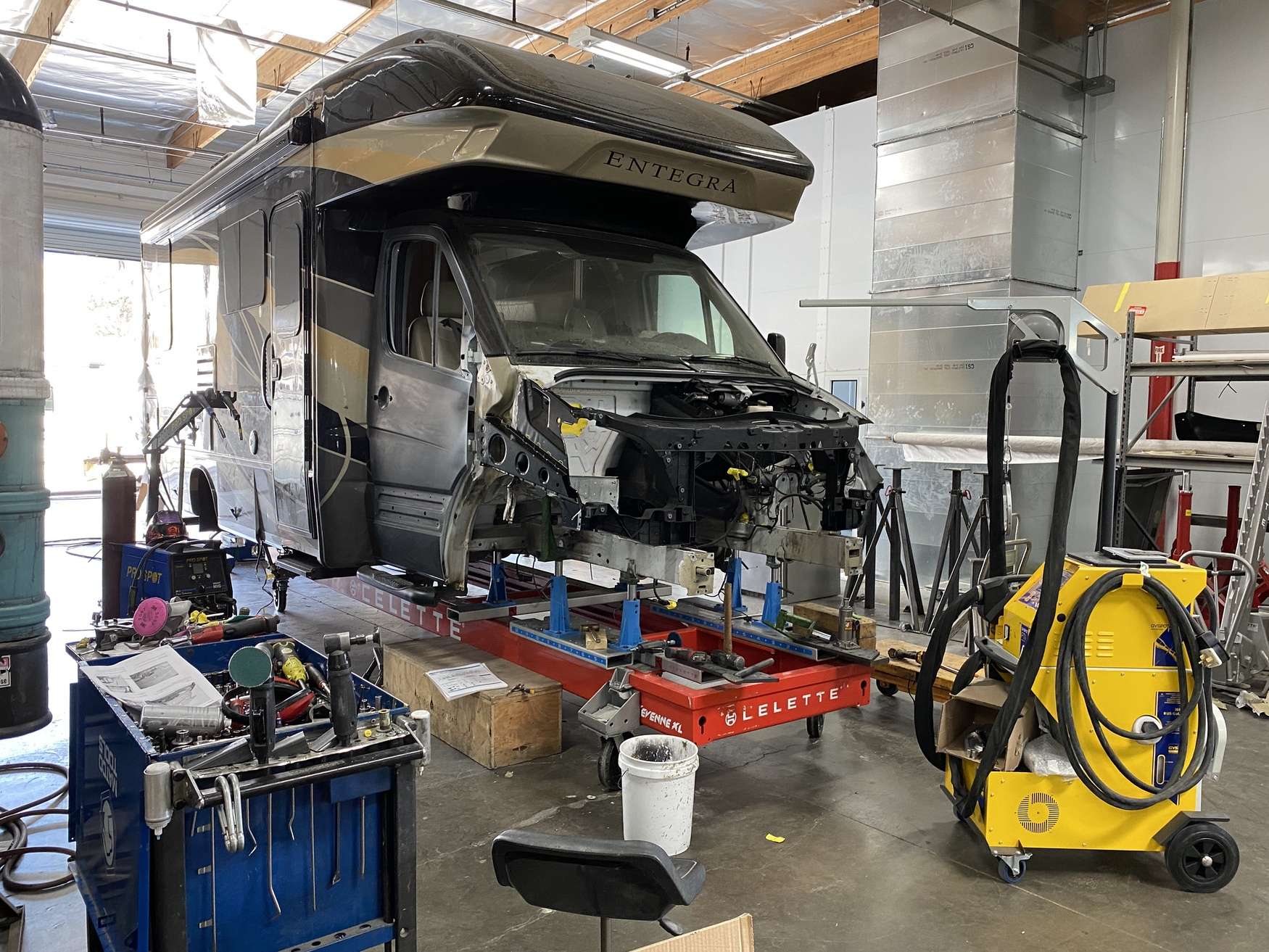
Why does the cabover leak on almost every Class C?
Geometry. The cabover is a box that hangs forward over the cab, unsupported at the front, and it is assembled from a fiberglass nose cap, a front wall, two side walls and a roof, all meeting in corners that sit directly in the weather at highway speed. Every one of those joins is a sealed seam. Sealant is a consumable. It gets brittle in sun, it shrinks in heat, and it eventually opens a path.
Add movement. The cabover is the part of the coach that flexes the most, because it is cantilevered. Every bump works the joints. Sealant that is already brittle cracks first exactly there.
The three usual entry points, in order of how often they turn up on the bench here: the joint between the cabover nose cap and the front wall, the upper corner seams where the nose cap wraps around to the sides, and the clearance light or marker light mounts drilled through the nose. All three drip into the same place, which is the framing at the base of the cabover, directly above the windshield.
How do you find water damage before it is obvious?
By the time a ceiling stains, the framing has usually been wet for a couple of seasons. The estimator looks for it earlier than that.
- Press the cabover floor from inside, kneeling on it at the outer edges. A floor that flexes underfoot at the perimeter but not the centre points at wet perimeter framing.
- Press the walls where the nose cap meets the side wall. Luan that has been wet goes soft and papery and feels different under a thumb than dry board.
- Look along the outside of the nose in raking light for a bulge. Delaminated skin shows as a shallow wave before it shows as anything else.
- Check the inside of the cab headliner and the top of the windshield frame for staining. Water that gets into the cabover base runs down and finds the cab.
- Meter the suspect area. A moisture meter reading well above the surrounding panel confirms the map before anything gets cut.
Only then is the file written. Water damage restoration and subfloor replacement is posted at $750 to $15,000 across 4 to 60 hours, and the reason the band is that wide is that the difference between a wet corner and a wet cabover is measured in days of labor. Everything is on the prices page.
What does opening and rebuilding a wet cabover involve?
The sequence is not glamorous but it is what makes the repair last.
The interior panelling and the bunk platform come out first so the extent of the rot can be seen rather than guessed. The exterior skin is then cut back at a clean line beyond the wet zone. Wet insulation is removed entirely, because it holds water against fresh timber and will rot a new repair from the inside.
Framing is replaced member by member, matched to the original section, and the corner joints are rebuilt properly rather than sistered over. Where the subfloor is involved, the floor is cut back to sound material and new decking is bonded and fastened in.
Only then does the skin go back: new luan, new laminate, the outer skin bonded and clamped, then faired and refinished. The last step is the one people skip, which is resealing every joint and every penetration on the nose so the coach does not do it again. Roof recoat and reseal work is $750 to $4,500 across 4 to 20 hours.
What else takes damage on a Class C?
The rear overhang. A Class C on an E-450 or Transit cutaway has a long body behind the rear axle, and the departure angle is poor. Driveway aprons, steep gas station entries and speed humps all catch the rear underside. What gets hit is usually the rear bumper, the lower rear cap and, on some builds, the waste tank or the tank shield. Black and gray tank repair and replacement is posted at $750 to $8,500 across 5 to 35 hours.
Tail swing is the other one. The rear corner sweeps wide on a tight turn and catches posts and pillars. Rear cap corner damage is fiberglass cap work at $750 to $12,000 across 4 to 60 hours.
The dinette or galley slide, where fitted, is the third. Class C slides are usually smaller and lighter than a Class A slide, which is good, but the same failure modes apply: seal wear, rack and pinion or Schwintek motor faults, and room sag. Slide out mechanism service is $500 to $8,500 across 3 to 35 hours. See slide out repair.
Is it worth repairing an older Class C?
Often, yes, and more often than owners expect. Class C coaches hold value reasonably well, the chassis under them is common and serviceable, and a wet cabover is a bounded problem once you know how far it has gone. The honest answer depends on what the meter says and how much of the framing is involved, which is exactly what the walk establishes.
Where it is not worth it, you will be told so plainly. A coach with rot from the cabover through the sidewalls into the rear framing is a rebuild, not a repair, and there is no value in starting that job to find out halfway. Insurance walk ins carry no charge for a collision estimate, and an RV systems evaluation is $150 applied as a credit against an authorized repair.
What about the cab and chassis side?
The cutaway cab is a Ford or a Chevrolet or a Transit, and body work on it is straightforward automotive work: doors, hood, fenders, bumper. Cab body repair is posted at $750 to $12,000 across 5 to 60 hours. The interesting part is the junction between the OEM cab and the coach body, because the two are joined but flex independently, and a collision that moves the cab relative to the house tears the transition seal.
Engine and drive system work on the chassis is not performed here. Suspension, brakes at the wheel end, tires, chassis lube and everything structural is. Anything the coach body does is fully in scope.
What is included
- Moisture meter readings recorded before any panel is cut
- Complete removal of wet insulation rather than drying in place
- Framing replaced in matching section, with rebuilt corner joints
- Every roof and nose penetration resealed before the coach leaves
- Interior panelling and bunk platform refitted and finished
Questions we get asked
There is a stain on my cabover ceiling. How bad is it likely to be?
Worse than it looks, generally. Water tracks along framing before it stains a surface, so the stain marks where it emerged rather than where it entered. Expect the wet area to extend beyond the visible mark. A moisture meter reading and a press test at the seams will map it properly before any cutting starts.
Can you just reseal the roof instead of opening it up?
Only if the framing underneath is still dry. Resealing over rot traps the moisture and hides the problem while it keeps spreading. If the meter and the press test say the structure is sound, a reseal at $750 to $4,500 is the right and much cheaper answer. If it is not, sealing it is money spent to delay a bigger bill.
How long does a cabover rebuild take?
The posted band is 4 to 60 hours for water damage restoration, and a full cabover rebuild sits at the upper end because framing, skin, insulation and finish all have to go back in sequence with cure time between steps. Plan in weeks rather than days, and expect the estimator to give a firmer date once the wall is open.
Will the repair be visible from outside?
It should not be. The skin is cut at a controlled line, the laminate is rebuilt, and the surface is faired and refinished with a color matched blend into adjacent panels. On a gel coat coach with decals, decal replacement at $500 to $5,500 usually finishes the job cleanly.