
Travel Trailer Repair: A-Frame Tongue to Rear Cap
A travel trailer tows from an A-frame tongue behind the tow vehicle bumper, which puts its pivot point far behind the rear axle and makes it the most sway prone RV on the road. OCRV Center repairs tongue, body, cap and roof damage in shop. Body work is posted at $750 to $50,000 across 5 to 250 hours.
Ballpark range $750 to $50,000 at 5 to 250 hours of labor. See the posted rate card.
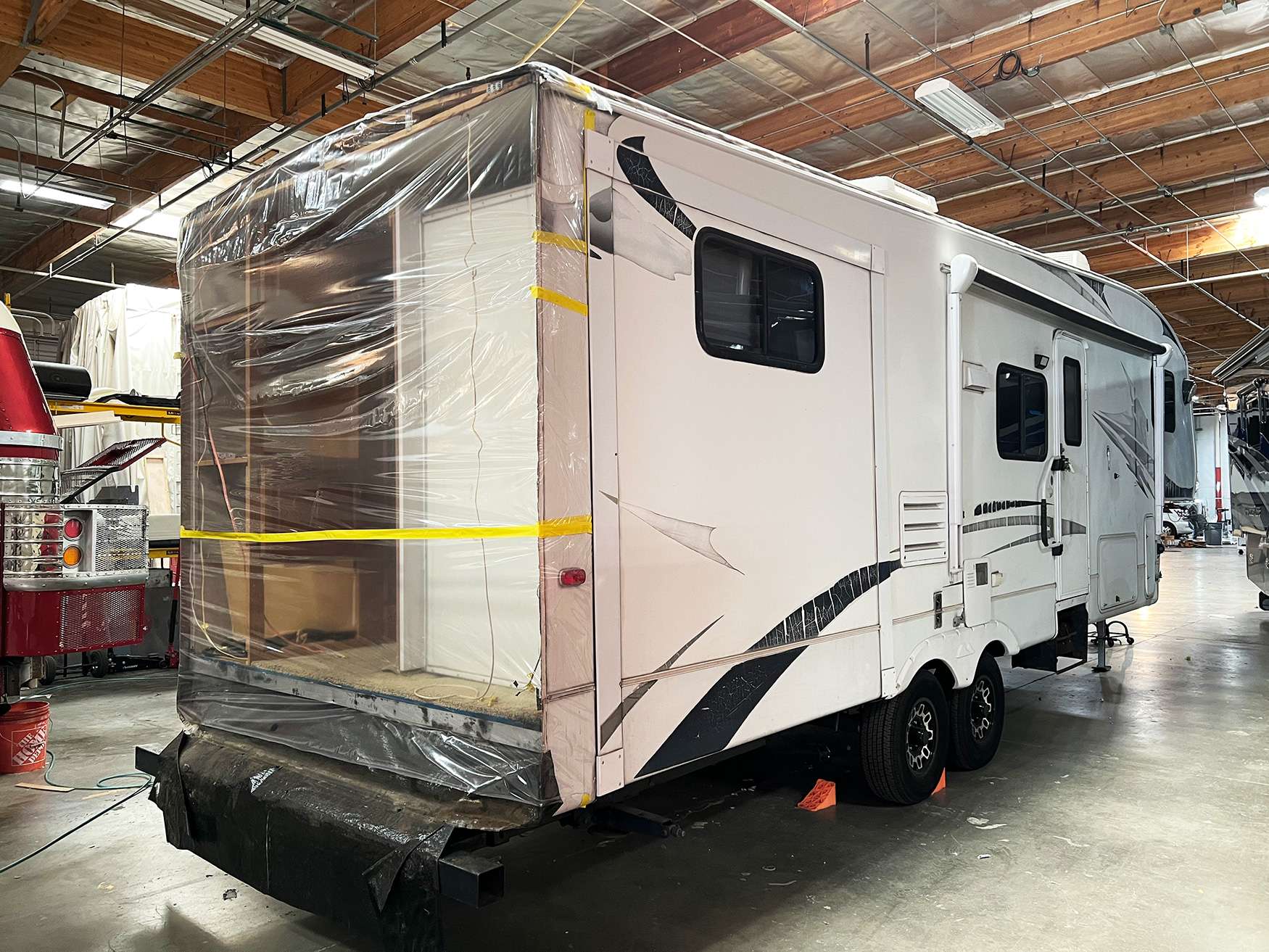
Why does a bumper pull behave differently to a fifth wheel?
Because of where the pivot is. A fifth wheel pivots above the tow vehicle's rear axle, so a disturbance at the trailer is resisted directly by the truck's suspension. A travel trailer pivots at a ball several feet behind that axle, which turns the whole tow vehicle into a lever the trailer can push sideways.
That geometry is why sway is a travel trailer problem and rarely a fifth wheel one, and why weight distribution hitches and sway control exist at all. It also explains the specific damage that arrives at the shop: rear corner and cap damage from a sway event, tongue and A-frame damage from a jackknife, and sidewall damage where a swaying trailer has contacted something.
Hitch receiver and weight distribution installation is posted at $400 to $2,500 across 2 to 10 hours, and tongue, coupler and safety chain repair at $250 to $1,500 across 1 to 6 hours. Both matter more on a bumper pull than on anything else towed.
What happens to the A-frame tongue?
It is the most highly stressed piece of steel on the trailer and it is completely exposed. Two members converge from the main frame rails to a single coupler, carrying the tongue weight, the braking loads and every sway input in bending and torsion at the same time.
- Coupler wear at the latch and the ball socket, which lets the trailer move on the ball and hammer the coupler oval.
- Bending in the A-frame members from a jackknife, which is visually subtle and measurable.
- Cracks at the weld where the members join the main rails, which is where the bending moment peaks.
- Jack mount tearing, usually from lifting on a jack that was not fully retracted or from a sunk foot.
- Propane tank and battery tray mounts corroding, since the tongue collects everything the tow vehicle throws.
- Breakaway cable and seven way wiring damage, the last of which is posted at $200 to $800 across 1 to 4 hours for connector repair.
Structural welding and repair is posted at $750 to $20,000 across 5 to 80 hours, though tongue work usually sits at the lower end. A bent A-frame is measured against the frame rather than eyeballed. See frame and structural repair.
Why is the front cap always chipped?
Because it lives directly behind the tow vehicle's rear tyres with nothing in between. A fifth wheel's front cap is up high and partly shielded by the truck's cab. A travel trailer's front cap is at the same height as the road spray, and it takes every stone the tow vehicle throws.
Gelcoat under sustained stone impact chips, then the chips craze, then water gets into the laminate behind and starts a delamination that can spread a long way from where it began. Catching it while it is chips is cheap. Catching it after the laminate is wet is not.
Fiberglass cap repair front and rear is posted at $750 to $12,000 across 4 to 60 hours, delamination repair at $1,500 to $20,000 across 10 to 100 hours, and full cap replacement at $4,500 to $25,000 across 30 to 120 hours. Front stone guards and diamond plate protection are fabrication items quoted per trailer.
What does a travel trailer need on a maintenance schedule?
Four things, and neglecting any of them accounts for most of what arrives here as a surprise. Roof sealant, wheel bearings, brakes and seals.
Roof recoat and reseal is posted at $750 to $4,500 across 4 to 20 hours and is the single highest value preventive job on any trailer, because a roof leak becomes a subfloor job faster than owners expect. Water damage restoration and subfloor replacement runs $750 to $15,000 across 4 to 60 hours by comparison.
Wheel bearing repack and hub service is $250 to $1,200 across 1 to 5 hours, electric, surge and hydraulic brake service is $300 to $5,500 across 1 to 22 hours, and trailer annual maintenance service is $300 to $1,500 across 2 to 6 hours. Trailer suspension service across leaf, torsion and air ride sits at $400 to $6,500 across 2 to 25 hours. All are on the prices page.
Questions we get asked
My trailer swayed badly and now the rear corner is damaged. What else should be checked?
The A-frame and the frame rails, because a sway event that hard loads the tongue in bending. Body damage at the rear is the visible part. Measuring the frame tells you whether the trailer is still square, and a trailer that is not square will not tow straight afterwards.
The front of my trailer is covered in stone chips. Is that just cosmetic?
Only until the chips craze and let water into the laminate behind the gelcoat. At that point it becomes a delamination, which spreads and costs far more to repair. Repairing chips and fitting front protection is inexpensive by comparison.
Can you fit a weight distribution hitch and sway control?
Yes. Hitch receiver and weight distribution installation is posted at $400 to $2,500 across 2 to 10 hours, and tow hitch with seven way wiring at $500 to $2,500 across 2 to 10 hours. On a bumper pull this is the single most effective change to how the trailer behaves.
How often should a travel trailer roof be resealed?
There is no fixed interval, but in Southern California sun sealant ages faster than in most climates, and inspecting annually is sensible. The point of the inspection is to catch a sealant bead that has begun to shrink or lift before water finds the gap, not after.
Do you handle insurance claims on travel trailers?
Yes, and it is a large part of the work. The shop bills carriers direct including Progressive, State Farm, GEICO, Mercury, Allstate, Liberty Mutual and Foremost. Collision estimates carry no charge for insurance walk ins. Insurance billed jobs may use carrier negotiated labor rates that differ from posted retail rates.